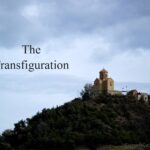

As a glorious preview of his Resurrection, Christ’s appearance dramatically and temporarily changed in front of his closest Apostles on Mt. Tabor. The events of the Transfiguration revealed that Jesus is the divine Son of God.
Soon after Peter proclaimed that Jesus was the Messiah, and only a week after Jesus first predicted his own passion and death, the Transfiguration strengthened the faith of the Apostles to prepare them.
Peter, James, and John witnessed Jesus’ face become intensely white while He spoke with Moses and Elijah on the mountain. Then, just as they did at Jesus’ Baptism, the three Apostles heard God the Father call Jesus his Beloved Son.
Moses represents the Law and Elijah represents the prophets. Their presence at the Transfiguration shows that Jesus is the fulfillment of all that had been promised in the Old Covenant.
The Transfiguration of Jesus is the 4th Luminous Mystery of the Rosary and is recounted in the Gospels of Matthew, Mark, and Luke. The story is always read from one of these synoptic Gospels on the 2nd Sunday of Lent as a reminder of the gift of hope.
The Church celebrates the Feast of the Transfiguration of the Lord each year on August 6.
A glimpse at the glory of the Lord:
Jesus’ divinity fully revealed:
A manifestation of divine glory:
About eight days after He said this, He took Peter, John, and James and went up the mountain to pray. While He was praying his face changed in appearance and his clothing became dazzling white. And behold, two men were conversing with Him, Moses and Elijah, who appeared in glory and spoke of his exodus that He was going to accomplish in Jerusalem. Peter and his companions had been overcome by sleep, but becoming fully awake, they saw his glory and the two men standing with Him. As they were about to part from Him, Peter said to Jesus, “Master, it is good that we are here; let us make three tents, one for You, one for Moses, and one for Elijah.” But he did not know what he was saying. While he was still speaking, a cloud came and cast a shadow over them, and they became frightened when they entered the cloud. Then from the cloud came a voice that said, “This is my chosen Son; listen to Him.” After the voice had spoken, Jesus was found alone. They fell silent and did not at that time tell anyone what they had seen.
Luke 9: 28-36
Jesus inaugurates a new Exodus:
Jesus is the fulfillment of the law and the prophets:
In the Transfiguration we not only contemplate the mystery of God, passing from light to light, but we are also invited to listen to the divine word that is addressed to us. Above the word of the Law in Moses and of the prophecy in Elijah, the voice of the Father can be heard referring to the voice of the Son, as I have just mentioned. In presenting his “beloved Son”, the Father adds the invitation to listen to Him. In commenting on the Transfiguration scene, the Second Letter of Peter emphasizes the divine voice. Jesus Christ “received honour and glory from God the Father and the voice was borne to Him by the majestic glory: “This is my beloved Son, with Whom I am well pleased’; we heard this voice borne from Heaven, for we were with Him on the holy mountain. And we have the prophetic word made more sure. You will do well to pay attention to this as to a lamp shining in a dark place, until the day dawns and the morning star rises in your hearts.”
Pope John Paul II, Homily, 26 April 2000
What happened to Jesus could happen to us:
His Father is our Father:
The Transfiguration gives us reason to hope:
The mystery of the Transfiguration strengthens faith:
On the threshold of the public life: the Baptism; on the threshold of the Passover: the Transfiguration. Jesus’ baptism proclaimed “the mystery of the first regeneration”, namely, our Baptism; the Transfiguration “is the sacrament of the second regeneration”: our own Resurrection. From now on we share in the Lord’s Resurrection through the Spirit who acts in the sacraments of the Body of Christ. the Transfiguration gives us a foretaste of Christ’s glorious coming, when He “will change our lowly body to be like his glorious body.” But it also recalls that “it is through many persecutions that we must enter the kingdom of God”:
Catechism of the Catholic Church 556
Peter did not yet understand this when he wanted to remain with Christ on the mountain. It has been reserved for you, Peter, but for after death. For now, Jesus says: “Go down to toil on Earth, to serve on Earth, to be scorned and crucified on Earth. Life goes down to be killed; Bread goes down to suffer hunger; the Way goes down to be exhausted on his journey; the Spring goes down to suffer thirst; and you refuse to suffer?”
Worshipping at the site of Jesus’ Transfiguration high on Mt. Tabor:
The Truth, Goodness, and Beauty of the Catholic Church
Looking up the beliefs of Catholics:
Share this page with friends and family to start a conversation about your faith.
Don’t miss a post. Learn more about the Catholic Church and strengthen your Catholic faith.
Find more Fiercely Catholic video issues here.
Subscribe here.