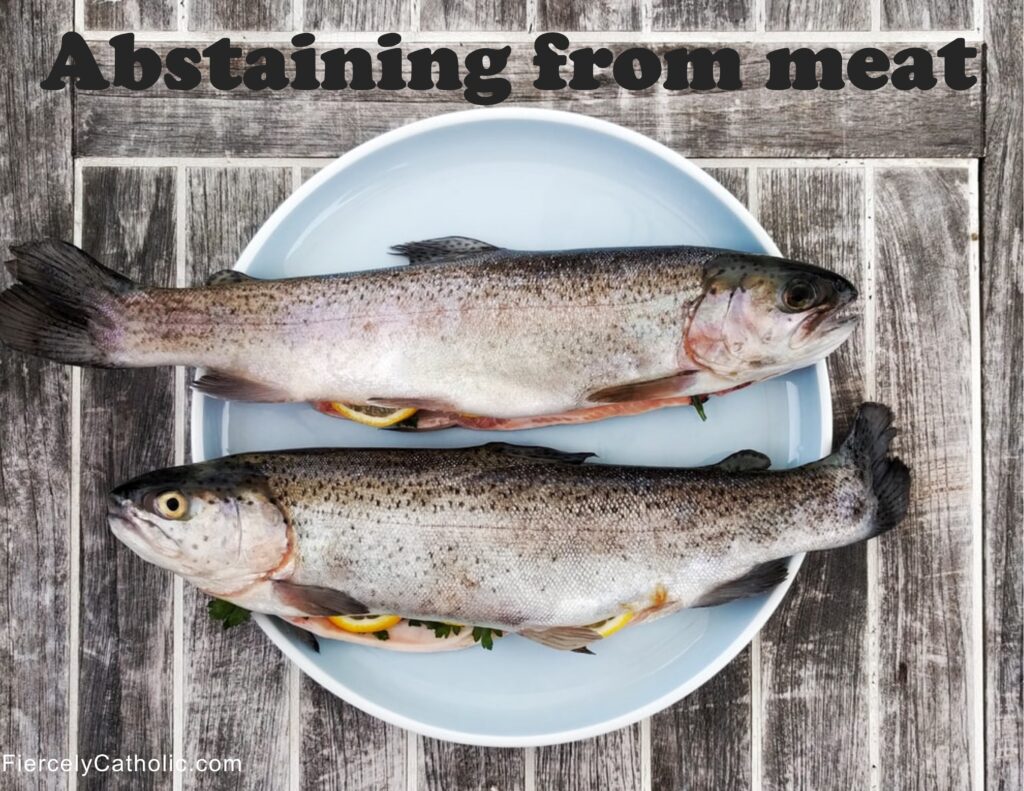
On Ash Wednesday, Good Friday, and all Fridays during Lent, Catholics 14 years of age and older are required to abstain from eating meat. Unlike fasting, which is eating less food, abstaining means avoiding certain foods.
Every Friday of the year recalls when Jesus’ sacrificed his flesh on the Cross on Good Friday. On Fridays during Lent, Catholics join themselves to his suffering by abstaining from the flesh of mammals and poultry.
Catholics also abstain from eating meat on Ash Wednesday which marks the beginning of Lent. Catholics fast and abstain on that solemn day while contemplating their mortality and their need to repent from sin.
Meat is an expensive delicacy in many cultures and is associated with feasting and celebrating, so abstaining and substituting with a more common or less desirable food is considered to be a sacrifice.
By not eating meat, which is good and necessary, Catholics show that they are even more dependent on God. The physical hunger that results from abstaining serves as a reminder of their spiritual hunger for God.
Practicing penitential acts such as abstaining from meat is a way for Catholics to develop self-control, build discipline, and exercise mastery over bodily passions so that they grow in holiness.
Abstaining from meat is intended to be a sacrifice so a Catholic who eats food that they enjoy even more than meat on Fridays during Lent is missing the point of the practice.
A Catholic farewell to meat:
Abstinence is a form of denying yourself of something:
Reminding Catholics of their hunger for God:
In those days I, Daniel, was mourning for three weeks. I ate no delicacies, no meat or wine entered my mouth, nor did I anoint myself at all, for the full three weeks.
Daniel 10: 2-3
Remembering the sacrifice that Christ made:
Friday is a day of preparation for Sunday and Jesus’ Resurrection:
The flesh of mammals and birds has been associated with celebration:
Fast and abstinence primarily strengthen the Christian for his struggle against evil and his service of the Gospel. Penance and fasting call the believer to give up lawful material goods and satisfactions in order to gain greater interior freedom, enabling him to hear the Word of God and generously help his brothers and sisters in need. Fast and abstinence, therefore, must be accompanied by acts of solidarity towards those who are suffering or going through difficult moments. Penance thus becomes a sharing with the marginalized and the needy.
Pope John Paul II, General Audience, 8 March 2000
Abstinence and other Lenten disciplines should carry into the whole year:
The fourth precept (“You shall observe the days of fasting and abstinence established by the Church”) ensures the times of ascesis and penance which prepare us for the liturgical feasts and help us acquire mastery over our instincts and freedom of heart.
Catechism of the Catholic Church 2043
Catholics have been abstaining from meat since the early Church:
Friday meals during Lent should be simple:
The Truth, Goodness, and Beauty of the Catholic Church
Life in a medieval monastery:
Share this page with friends and family to start a conversation about your faith.
Don’t miss a post. Learn more about the Catholic Church and strengthen your Catholic faith.
Find more Fiercely Catholic video issues here.
Subscribe here.