
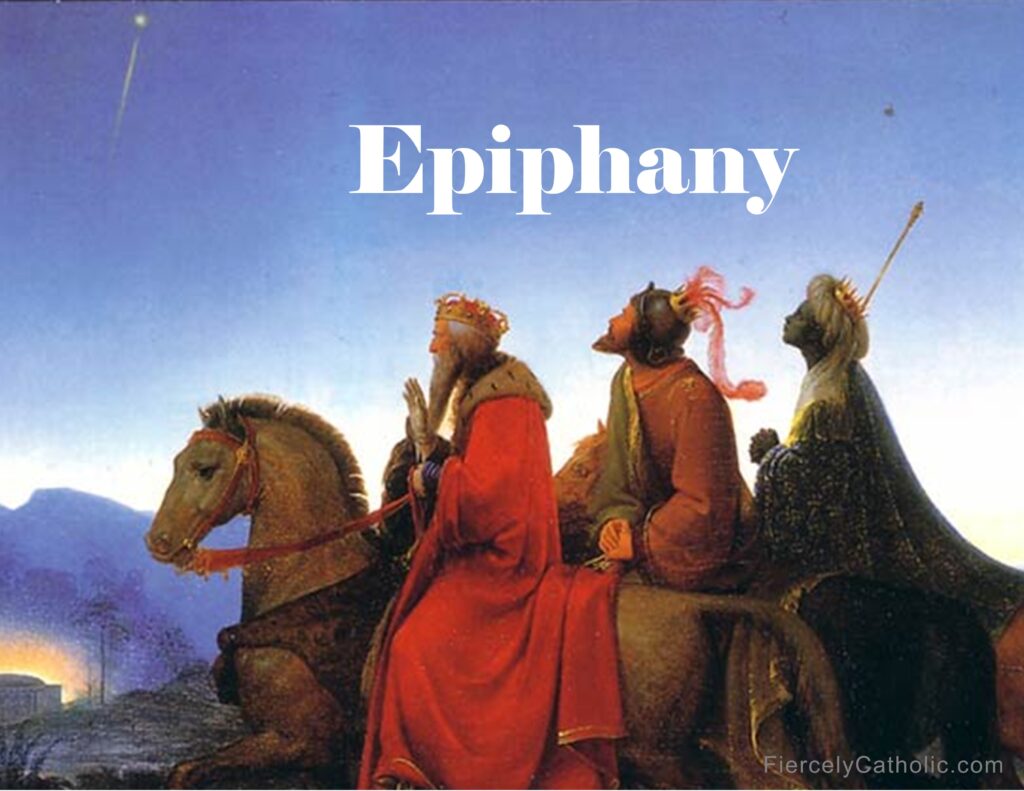
Recalling the event when wise men from the East visited the child Jesus and brought Him gifts, the Epiphany, or Manifestation of Christ, has been celebrated since earliest days of the Church.
The gifts of gold, frankincense, and myrrh that were brought for Jesus were prophesied in the Old Testament. These gifts also indicate Jesus’ roles as King, Priest, and Savior.
Sometimes referred to as kings or astrologers, these Magi had seen a new star in the East which they understood to signify the birth of a new king.
Representing the Gentile nations, these men show that Jesus did not come for a single nation or tribe but came for the whole world, hinting at Jesus’ great commission to baptize and make disciples of all nations.
The Bible does not provide their names but traditionally the wise men are called Balthazar, Gaspar, and Melchior. They are venerated as saints.
The Feast of the Epiphany has been traditionally celebrated on January 6 but is transferred to the first Sunday after January 1 in the United States.
Jesus’ identity was also revealed by God the Father at his Baptism and in performing his first miracle at the Wedding at Cana so those events are also attached to the Feast of the Epiphany.
Jesus Christ was revealed to the whole world:
A story with many characters and signs:
The Wise Men were looking for more:
They were overjoyed at seeing the star, and on entering the house they saw the child with Mary his mother. They prostrated themselves and did Him homage. Then they opened their treasures and offered Him gifts of gold, frankincense, and myrrh.
Matthew 2: 10-11
God reveals Himself:
Manifested to the whole world:
The Magi prostrated themselves:
The Magi represent those who have ever searched for the truth:
The Epiphany is the manifestation of Jesus as Messiah of Israel, Son of God and Savior of the world. The great feast of Epiphany celebrates the adoration of Jesus by the wise men (magi) from the East, together with his Baptism in the Jordan and the wedding feast at Cana in Galilee. In the magi, representatives of the neighboring pagan religions, the Gospel sees the first-fruits of the nations, who welcome the good news of salvation through the Incarnation. The magi’s coming to Jerusalem in order to pay homage to the King of the Jews shows that they seek in Israel, in the messianic light of the star of David, the One who will be king of the nations. Their coming means that pagans can discover Jesus and worship Him as Son of God and Savior of the world only by turning towards the Jews and receiving from them the messianic promise as contained in the Old Testament. The Epiphany shows that “the full number of the nations” now takes its “place in the family of the patriarchs”, and acquires Israelitica dignitas (is made “worthy of the heritage of Israel”).
Catechism of the Catholic Church 528
Jews and non-Jews were waiting for a king:
The Magi point toward the Church’s mission:
For the Church which believes and prays, the Wise Men from the East who, guided by the star, made their way to the manger of Bethlehem, are only the beginning of a great procession which winds throughout history. Thus the liturgy reads the Gospel which relates the journey of the Wise Men, together with the magnificent prophetic visions of the sixtieth chapter of the Book of Isaiah and Psalm 71, which depict in bold imagery the pilgrimage of the peoples to Jerusalem. Like the shepherds, who as the first visitors to the newborn Child in the manger, embodied the poor of Israel and more generally those humble souls who live in deep interior closeness to Jesus, so the men from the East embody the world of the peoples, the Church of the Gentiles – the men and women who in every age set out on the way which leads to the Child of Bethlehem, to offer Him homage as the Son of God and to bow down before Him. The Church calls this feast “Epiphany” – the appearance of the Godhead. If we consider the fact that from the very beginning men and women of every place, of every continent, of all the different cultures, mentalities and lifestyles, have been on the way to Christ, then we can truly say that this pilgrimage and this encounter with God in the form of a Child is an epiphany of God’s goodness and loving kindness for humanity
Pope Benedict XVI, Homily, 6 January 2013
Celebrating the Epiphany in Bethlehem:
The Truth, Goodness, and Beauty of the Catholic Church
Saying “yes” to God:
Share this page with friends and family to start a conversation about your faith.
Don’t miss a post. Learn more about the Catholic Church and strengthen your Catholic faith.
Find more Fiercely Catholic video issues here.
Subscribe here.


